

Every broadcast archive project eventually hits the same question: wait for one large budget, or build in phases from what already exists?
Both can work. We've seen projects move end-to-end on parliamentary allocations, foundation trusts, or EU funds. We've also seen archives with no dedicated budget line make equal progress by splitting the work into stages — inventory, digitization, access, integration. The difference isn't the money. It's whether each phase produces something that still works if the next phase is delayed, the vendor changes, or the target systems change entirely.
Inventory
Most archives we encounter have no barcoding, no format classification — nothing beyond a shelf list or a spreadsheet. Registering items into a stable relational database, with scanned tandem material, takes 2-5 minutes per item. That gives IT a real dataset to plan against, independent of whatever digitization tooling comes next.
Digitization
The constraint here is rarely money — it's throughput and reliability. Manual, 1:1 listening workflows cap out around 4 carriers a day, which pushes institutions toward outsourced quotes of 25-30 EUR per carrier — a 3-5M EUR line item that competes with everything else in the IT budget, and in practice often never gets approved.
A workflow-driven approach (we use NOARecord, FrameLector, jobDB and actLINE for this) changes the throughput math, and keeps the archive off third-party's risk — no exposure to a logistics failure or increased handling cost in foreign countries. RÚV in Iceland runs this at production scale.
Access
This is where MAM choice matters more than people expect. Institutions that try to solve archive access inside their existing production system usually spend years going in circles over which MAM to adopt.
Kuwait Radio, Slovenian Television, Slovak Television, Swedish Radio, VRT avoided that: catalogue and release through mediARC end-to-end, no separate access debate. RTS Serbia recently took a similar step — investing in MAW to open internal access to years of digitized Radio Serbia content, without a parallel platform decision to slow things down.
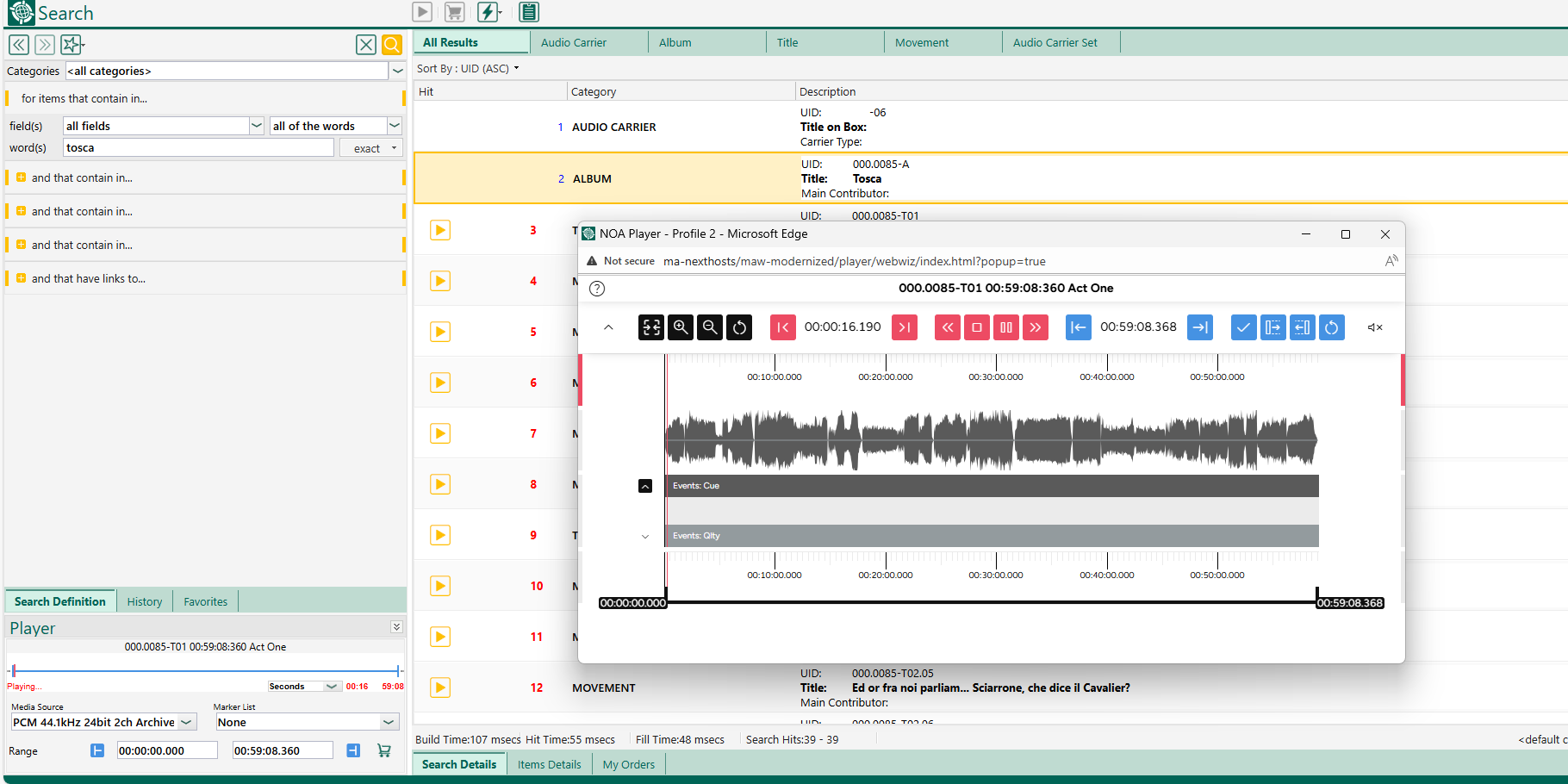
MAW search interface — browser-based search and playback of a digitized carrier
Integration
The phase where interfaces matter most — and where we'd ask any CIO to be blunt with vendors. APIs to Avid, Dalet, or any production system will get renegotiated or broken within a few years, because production systems change. A media file paired with a metadata XML file won't. Anyone designing archive integration with a 10-year view already knows this.
The Takeaway
None of this requires choosing between "the one big budget" and "step by step." It requires deciding, up front, that each phase has to stand on its own — techically and operationally — regardless of the funding model that got you there.
Happy to walk through where a phased architecture would fit your current systems.