
The Rocky Horror Picture Show of Archives
Kelly Pribble described the worst moulded tapes imaginable and his mitigation strategies. Nadja Wallaszkovits reported from a near-abandoned archive in Guinea-Bissau. Sebastian Gliga and Jack Harrison from PSI Paul Scherrer showed impressive contactless extraction of audio and film from catastrophically damaged material.
Remarkable work. Boutique work. Essential — and deliberately so.
Australia declared in 2021 the year 2025 as the practical end of viable digitization. At JTS 2026 in Canberra, the National Archives of Australia refined that to 2030.
My Own Predictions Have Been Wrong Before
In 2006, we built mediARC — our Archive Asset Management platform — partly because we believed ingest wouldn't last past 2010. We were convinced the window was closing.
Twenty years later, ingest is still one of our most active business areas. In the last two years alone, NOA digitization factories have been contracted to process more than 2 million carriers in 24 months — in Kuwait, Abu Dhabi, Denmark and Portugal.
So I'll stop making end-date predictions. History has made a fool of me often enough.
The 2% vs. 98% Problem — and Why It Matters for Your Strategy
The "Rocky Horror" formats — 2", 1"B, severely degraded or abandoned material 1/4" tapes — are genuinely at risk. They require boutique handling, specialist service providers, and extraordinary care.
They also typically represent 2–5% of an undigitised broadcast archive.
The other 95%+ is manageable — if you approach it correctly. In a broadcast archive, that means Betacam family on the video side. But it equally means ¼" open-reel audio tape, CDs, DAT´s and cassette formats that make up the bulk of most radio and TV @heritage collections. Different formats, same logic: large volumes, available machines, solvable problems.
The critical factor is not the machine alone — it is what happens to the tape before it enters the machine. A properly cleaned carrier, passing through a well-maintained transport, puts far less stress on heads than an uncleaned one. That is where real head longevity comes from — and where the difference between 5,000 and 20,000 hours of usable head life is actually decided. Fortunately, tape cleaners are again available on the market for virtually all formats.
This is exactly what NOA FrameLector was built for.
Knowing that a clean tape protects your machine is one thing. Knowing when your machine is still performing reliably at 15,000 or 20,000 hours — that requires data.
NOA FrameLector performs RF signal analysis and ISR extraction on playback — giving you a real-time, objective picture of head condition and machine performance. Instead of replacing heads on a calendar, you replace them when the signal tells you to.
That means:
- Fewer unnecessary machine interventions
- Confidence to run longer head life cycles where the signal justifies it
- Early warning before dropout rates affect archive quality
In a factory environment processing hundreds of thousands of carriers, this is not a marginal gain. It is the difference between a reactive and a proactive operation.
But First: Know What You Have
Before you can prioritize the good apples, you need to see the whole orchard.
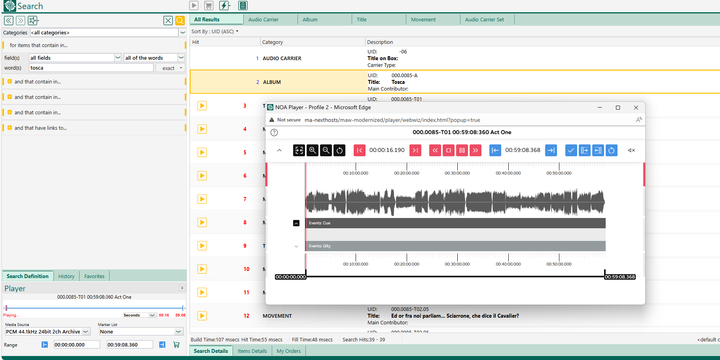
NOA jobDB is our carrier-level digitization database — designed for exactly this challenge. It gives archive managers a structured, searchable view of every carrier, its format, its condition data, after a thorough inventory process.
Without this visibility, you are making strategic decisions about thousands of carriers based on estimates and spreadsheets. With it, you can triage intelligently — separating the 95% that can be processed efficiently from the 2–5% that need specialist intervention — and build a digitization plan that is defensible, fundable, and executable.
The Practical Advice I Gave the Panel
Start with the good apples.
Protecting 95% of a broadcast heritage is a better outcome than protecting nothing while waiting for a perfect solution to the remaining 5%. The Betacam family archive, the ¼" audio collection, the CD and DAT library sitting in your facility right now — in reasonable condition, these are solvable problems. With the right tools, the right machines, and the right data.
We can help you build and run that operation — on-site, without shipping a single carrier.
When is the end?
Five years? Ten? I won't say anymore.
What I will say: the window is finite, the 95% is still reachable, and the tools to do it properly exist today.
If your archive is still waiting — let's talk.