
For any broadcast IT leader, the hardest part of a digitization project usually isn't the technology — it's the sequencing. Analog decay doesn't wait for a fiscal year, but budgets rarely arrive in one lump sum. The real engineering challenge is designing a system where every phase is a complete, working deliverable on its own, and every subsequent phase builds on it without rework, re-platforming, or re-training.
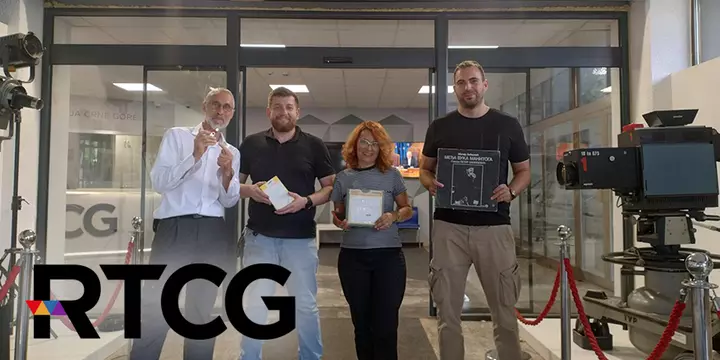
That's the challenge Radio Television of Montenegro (RTCG) and NOA GmbH set out to solve together — delivered in partnership with BFE Austria as system integrator and general contractor for the total project — and, three years and three contracted phases later, have delivered.
A phased investment only works if the architecture behind it doesn't compromise. RTCG's project is our sixth installation in the region, and it confirms what we've seen every time: a well-designed data model and a modular platform let institutions build a fully professional archive exactly as fast as their budget allows — without ever having to re-do earlier work.
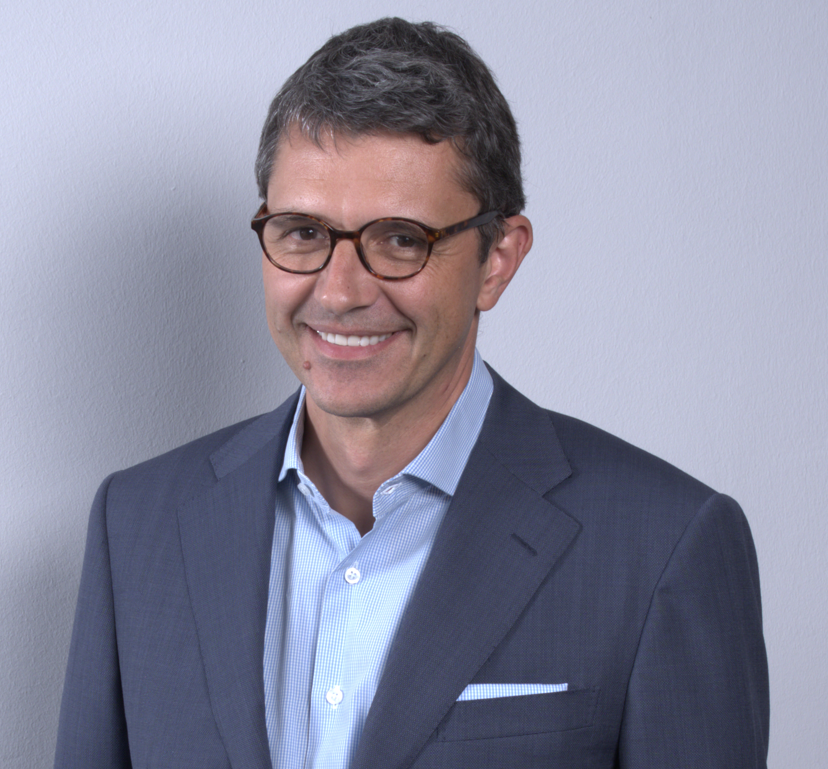
Jean-Christophe Kummer, Managing Director, NOA GmbH
The Starting Point: A Collection, Not Yet a System
RTCG's archive held decades of video, audio, and film carriers with no unified registry, no consistent location tracking, and no digital pipeline connecting physical media to a usable digital asset. Before any transcoding hardware or storage platform made sense, RTCG needed to know, with certainty, what it had and where it was — and NOA and RTCG treated that first step as Phase 1 of the production system itself, built on the same platform, data model, and identifiers that would carry through to the final ingest environment.
Phase 1 — Inventory as Infrastructure
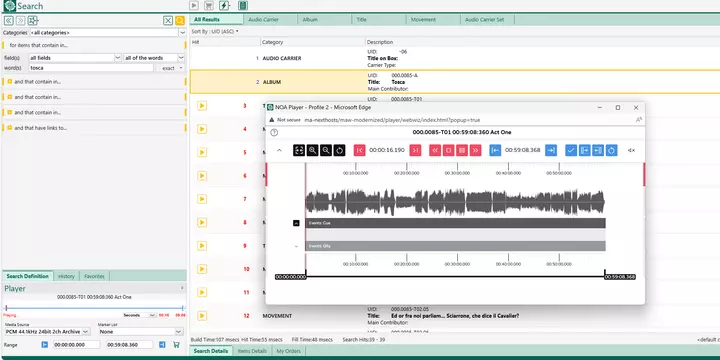
The first phase delivered a working registration system built on NOA's mediARC Archive Asset Management platform: a dedicated database server, application server, and general processing path, feeding four TV registration workstations and one radio workstation.
- A structured, non-flat relational mediARC metadata model was defined for Carrier and Carrier Set entities from day one, with every field (UID, Home Location, Carrier Type, condition, provenance) scoped with mandatory/read-only rules and controlled vocabularies- so data entered in Year 1 required no cleanup by Year 3.
- A three-tier barcode system (Carrier UID, Carrier Type command codes, Home Location) linked each physical item to its shelf and its future digital record before a single file existed — the addressing scheme ingest workflows would later resolve against automatically.
- A semi-automated, workflow-driven process in mediARC's UniversalDialoger meant the same application framework used for registration would later host the digitization workflows, with no discontinuity for staff.
The outcome: roughly 50,000 physical carriers on a path to being uniquely and permanently addressable — the precondition for everything that followed.
Phase 2 — Extending the Platform, Not Replacing It
Phase 2 extended the same mediARC installation with the components a production archive needs: a dedicated GPP and transcoding server, NOA FileManager, NOA StorageConnector UNC, NOA VideoScanner, NOA WaveScanner, and NOA VideoFileAnalyzer — plus multi-instance NOA MediaButler for transcoding throughput.
- Storage abstraction, not storage lock-in. StorageConnector UNC was positioned as the only point of entry to long-term storage, over standard CIFS, restricted to the archive system alone — keeping RTCG's storage hardware choices decoupled from NOA's application layer.
- Data integrity by construction. Every file entering long-term storage is registered with a unique identifier and an MD5 checksum at ingest, with video and audio normalized to preservation formats (FFV1, BWF) alongside access-tier proxies.
- Policy-driven storage management. Tiering, LTO backup, and file stubbing were handed to the storage platform's own Hierarchical Storage Management, reducing the surface area NOA's software needs to maintain over the system's lifetime. Here a cooperation with XenDATA was chosen, which was already successful at RTV Slovenija.
Phase 3 — Closing the Loop: Full Ingest, in Production
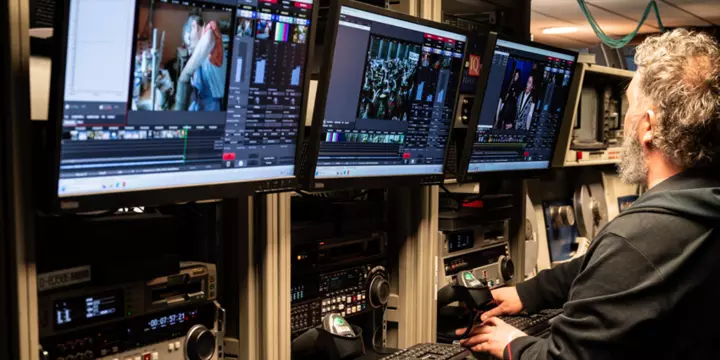
The final phase activated dedicated video (NOA FrameLector), audio (NOARecord), and CD (NOA CDLector) ingest workstations, standard ingest workflows, format-specific transcoding (AVC-Intra, XDCAM HD422, DVCPro), and a mediARC WEB intranet frontend — extending access beyond the original registration workstations.
Critically, no new logistics model, identifier scheme, or training foundation was required. Carriers already had UIDs and Home Locations from Phase 1; digitization requests trigger from the same mediARC GUI archivists already used, and ingested files resolve automatically against existing carrier items via UID-prefixed filenames — closing the loop from physical carrier to checksum-verified preservation file, all inside one platform, accumulated over three fiscal years without a single architectural discontinuity.
Navigating a multi-year project requires complete trust between internal engineering and external partners. Across the entire roll-out, the RTCG team experienced zero friction — working on the same robust platform with the same dedicated experts from NOA and BFE Austria. Together, we maintained flawless operational continuity from our very first carrier registration to full digital ingest, delivering a future-proof archive exactly as planned.
Zoran Grba, Head of Broadcast IT Systems, RTCG
Why the Phased Approach Worked
For CTOs, CIOs, and broadcast engineering leads evaluating a multi-year digitization investment, the RTCG project demonstrates a specific, replicable pattern:
- Design the data model once, correctly, before spending on hardware. The metadata scheme and identifier structure from Phase 1 required zero rework across two subsequent phases and hardware generations.
- Separate the storage platform from the archive application layer. A well-defined connector interface means storage vendor decisions and archive software decisions can be made on independent timelines.
- Treat each phase as a production milestone, not a pilot. RTCG had a working, staffed, in-use system after Phase 1 — real work on real infrastructure, not a proof of concept.
- Let workflow and interface consistency reduce long-term support burden. One platform, one workflow engine, one vendor accountable for interoperability across all three phases.
RTCG now operates a complete inventory-to-ingest pipeline, built to preservation standards, on infrastructure it controls, delivered exactly as fast as its budget allowed — proof that an institution doesn't need an enterprise-sized capital outlay on day one to build something durable.
———————
About RTCG
Radio and Television of Montenegro (RTCG) is the national public service broadcaster of Montenegro, with origins dating back to 1949 through Radio Titograd, while its television service began broadcasting in 1964. Following Montenegro's independence in 2006, RTCG became the country's independent public broadcaster. Its mission is to provide impartial news, educational, cultural, and entertainment programming that serves all citizens, promotes democratic values, preserves Montenegro's cultural heritage, and supports the Montenegrin language and minority communities. RTCG operates multiple television and radio channels as well as digital media services, with a mandate to deliver trusted, universally accessible public service content.